Thursday, 5 May 2016


Hello dear all,

check the video and write your commets.

thanks bye bye.

Monday, 2 May 2016

Dinosaur Die Out Was Gradual, Miserable, Painful

Dinosaur Die Out Was Gradual, Miserable, Painful

Dinosaurs gradually began to die out at least 40 million years before the devastating asteroid impact killed the rest in a dramatic way about 66 million years ago, concludes an extensive new study.
The research, outlined in the journal Proceedings of the National Academy of Sciences, is the first to incorporate phylogenetic information — meaning how species are related to one another — when studying speciation and extinction in dinosaurs.
The data provides evidence that things went from really bad to worse for most dinosaurs that did not evolve into birds.
Its name might be a tongue-twister, but Leikupal Laticauda has vaulted into the upper reaches of dinosaur stardom. Why? Because it lived after almost nothing else did.
“Some dinosaurs definitely would have been instantly killed in the impact, those in the vicinity of the impact site for instance; others may have perished in the tsunami caused by the blast,” lead author Manabu Sakamoto of the University of Reading’s School of Biological Sciences told Discovery News.
He continued, “The majority of the remaining dinosaurs all over the rest of the world would have likely starved to death as vegetation died out owing to the layer of ash that blacked out the sky (nuclear winter).”
A model created by Sakamoto and colleagues Michael Benton and Chris Venditti found that most dinosaur populations were already declining as early as 48–53 million years before the asteroid impact, which left the massive Chicxulub crater in Mexico. They say that the Cretaceous Period was a time of extreme geological and environmental changes.
“For instance,” Sakamoto said, “sea level was fluctuating, climate was shifting from a hot house to a global cooling, there were prolonged volcanic activities, and continents were breaking apart, establishing the main continents we have today.”
He explained that the supercontinent breakup would have resulted in less available land for dinosaurs to use for migration, which previously helped to fuel the evolution of new species. Climate change, both then and now, could induce major environmental and ecological shifts.
Sea level rise turned out to be more complex. Initially, it favored the evolution of more dinosaur species, but smaller land areas eventually restricted population growth.
Our ancestors, the early mammals, could have posed a big threat to dinos as well.
“Another possibility is that mammals, which were small rodent-like creatures at that time, were in some way contributing to the dinosaur’s downfall,” Benton, a professor of vertebrate paleontology at the University of Bristol, told Discovery News. “Recent studies show evidence that mammals were on the rise prior to the K-Pg (extinction) event, so this scenario would be consistent with our finding.”
Venditti, from the University of Reading, added that mammals might have outcompeted dinosaurs for resources, eaten their eggs, spread diseases or caused other problems for the once mighty dinos.
Aside from the dinosaur lineage that evolved to become birds, two other major groups of dinosaurs — the plant-eating hadrosaurs and ceratopsians — remained strong until the asteroid struck. Sakamoto explained that these dinos acquired specialized jaw structures that allowed them to process plant foods efficiently.
Paleontologist Steve Brusatte from the University of Edinburgh’s School of GeoSciences said the new study is an impressive take on “a subject that has been studied to death.”
"Cretaceous dinosaurs were evolving into fewer new species, and going extinct at a faster rate, than earlier dinosaurs,” said Brusatte. But he does not think that dinosaurs were doomed to extinction before 66 million years ago.
“The asteroid hit at a time when dinosaurs had already been around for a long time, and had already endured their really prolific periods of evolution,” Brusatte said. “But the way I see it, the dinosaur extinction still came down to the asteroid. No asteroid, no extinction."
There is an eerie footnote regarding lessons learned from the extinction of dinosaurs, and other animals that bit the dust after the asteroid hit. Any group of animals that is under a prolonged period of decline can be wiped out, should there be catastrophic event.
Sakamoto said, “This means that if some major catastrophe hits, then it is highly possible that whole groups of animals could be completely wiped off the face of the Earth.”

New Titanosaur: Big Body, Small Brain, Major A


Wednesday, 6 April 2016

Dinosaurs


The prehistoric reptiles known as dinosaurs arose during the Middle to Late Triassic Period of the Mesozoic Era, some 230 million years ago. They were members of a subclass of reptiles called the arc


Scientists first began studying dinosaurs during the 1820s, when they discovered the bones of a large land reptile they dubbed a Megalosaurus (“big lizard”) buried in the English countryside. In 1842, Sir Richard Owen, Britain’s leading paleontologist, first coined the term “dinosaur.” Owen had examined bones from three different creatures–Megalosaurus, Iguanadon (“iguana tooth”) and Hylaeosaurus (“woodland lizard”). Each of them lived on land, was larger than any living reptile, walked with their legs directly beneath their bodies instead of out to the sides and had three more vertebrae in their hips than other known reptiles. Using this information, Owen determined that the three formed a special group of reptiles, which he named Dinosauria. The word comes from the ancient Greek word deinos (“terrible”) and sauros (“lizard” or “reptile”).
Since then, dinosaur fossils have been found all over the world and studied by paleontologists to find out more about the many different types of these creatures that existed. Scientists have traditionally divided the dinosaur group into two orders: the “bird-hipped” Ornithischia and the “lizard-hipped” Saurischia. From there, dinosaurs have been broken down into numerous genera (e.g. Tyrannosaurus or Triceratops) and each genus into one or more species. Some dinosaurs were bipedal, which means they walked on two legs. Some walked on four legs (quadrupedal), and some were able to switch between these two walking styles. Some dinosaurs were covered with a type of body armor, and some probably had feathers, like their modern bird relatives. Some moved quickly, while others were lumbering and slow. Most dinosaurs were herbivores, or plant-eaters, but some were carnivorous and hunted or scavenged other dinosaurs in order to survive.
At the time the dinosaurs arose, all of the Earth’s continents were connected together in one land mass, now known as Pangaea, and surrounded by one enormous ocean. Pangaea began to break apart into separate continents during the Early Jurassic Period (around 200 million years ago), and dinosaurs would have seen great changes in the world in which they lived over the course of their existence. Dinosaurs mysteriously disappeared at the end of the Cretaceous Period, around 65 million years ago. Many other types of animals, as well as many species of plants, died out around the same time, and numerous competing theories exist as to what caused this mass extinction. In addition to the great volcanic or tectonic activity that was occurring around that time, scientists have also discovered that a giant asteroid hit Earth about 65.5 million years ago, landing with the force of 180 trillion tons of TNT and spreading an enormous amount of ash all over the Earth’s surface. Deprived of water and sunlight, plants and algae would have died, killing off the planet’s herbivores; after a period of surviving on the carcasses of these herbivores, carnivores would have died out as well.
Despite the fact that dinosaurs no longer walk the Earth as they did during the Mesozoic Era, unmistakable traces of these enormous reptiles can be identified in their modern-day descendants: birds. Dinosaurs also live on in the study of paleontology, and new information about them is constantly being uncovered. Finally, judging from their frequent appearances in the movies and on television, dinosaurs have a firm hold in the popular imagination, one realm in which they show no danger of becoming extinct.

Cannibal Clues Worsen Tyrannosaurus Rex’s Bad Rap

 
As if its reputation weren't bad enough already, scientists have unearthed new evidence that Tyrannosaurus rex was one of fiercest predators the world has ever seen. It turns out the 7-ton, 13-foot-tall monster may have had a taste for its own kind.
Meals were a gruesome production for Tyrannosaurus rex, one of the largest—and toothiest—creatures to ever stalk the earth. For the most part, the king of dinosaurs probably subsisted on its slower, smaller, vegetarian brethren, such as duck-billed hadrosaurs like Edmontosaurus and horned ceratopsians like Triceratops. It used its incredible speed and massive jaw to hunt and slay its victims, but it also wasn’t above scavenging for dead animals. Some scientists have even theorized that T. rex poisoned its struggling prey with toxic saliva, much like the modern-day Komodo dragon.
According to a recent study, T. rex’s rather brutal feeding patterns may also have included one of humanity’s most unspeakable taboos: cannibalism. Paleontologist Nicholas Longrich of Yale University discovered giant tooth marks half an inch deep in arm and foot bones from Tyrannosaurus rex fossils found in western North America and dated to the late Maastrichtian period. Given the size and shape of the gouges, another T. rex is the only possible culprit.
“They’re the kind of marks that any big carnivore could have made, but T. rex was the only big carnivore in western North America 65 million years ago,” Longrich explained in a statement.
Writing in the October 15 issue of the journal PLoS ONE, Longrich and his colleagues said it was unlikely that the gashes resulted from claw-to-claw combat, which scientists believe was common behavior for Tyrannosaurus rex. Battling dinosaurs would probably have lunged for each other’s more vulnerable areas, such as the head and flanks, rather than the feet and arms. Instead, the researchers suggested, a hungry Tyrannosaurus probably came across the carcass of another while scavenging for food. Alternatively, the victor of a violent intraspecies squabble may have celebrated by eating its dead opponent, toes and all.
The researchers found four examples of T. rex cannibalism within a small sample of tooth-marked bones, an indication that the practice was rampant rather than a last resort in desperate times. (In other words, there’s no evidence of a dinosaur Donner Party.) This finding is hardly surprising: In 2007, a team of scientists made a compelling case for cannibalism in another theropod, Majungasaurus, which existed several million years before Tyrannosaurus.
Today, cannibalism occurs in every corner of the animal kingdom, especially among large carnivores such as bears, hyenas and alligators. Smaller critters do it too, including scorpions, rattlesnakes and, perhaps most notoriously, female praying mantises, which decapitate their mates during sex. For some species, cannibalism is so instinctual it starts before birth: Sand tiger sharks, for instance, are known to devour their siblings while still in the womb.
The study is significant because it sheds new light on the diets and feeding habits not only of Tyrannosaurus rex but also of other gigantic predators that left their massive footprint in the fossil record. “Given that cannibalism is known in Tyrannosaurus, Majungatholus and many extant, large-bodied carnivores, this behavior is likely to have been widespread in large, carnivorous dinosaurs,” the researchers wrote.
Sixty-five million years ago the last of the non-avian dinosaurs went extinct. So too did the giant mosasaurs and plesiosaurs in the seas and the pterosaurs in the skies. Plankton, the base of the ocean food chain, took a hard hit. Many families of brachiopods and sea sponges disappeared. The remaining hard-shelled ammonites vanished. Shark diversity shriveled. Most vegetation withered. In all, more than half of the world's species were obliterated.
What caused this mass extinction that marks the end of the Cretaceous and the beginning of the Paleogene? Scientists have yet to find an answer. The one that does must explain why these animals died while most mammals, turtles, crocodiles, salamanders, and frogs survived. Birds escaped. So did snails, bivalves, sea stars (starfish), and sea urchins. Even hardy plants able to weather climate extremes fared OK.
Scientists tend to huddle around one of two hypotheses that may explain the Cretaceous extinction: an extraterrestrial impact, such as an asteroid or comet, or a massive bout of volcanism. Either scenario would have choked the skies with debris that starved the Earth of the sun's energy, throwing a wrench in photosynthesis and sending destruction up and down the food chain. Once the dust settled, greenhouse gases locked in the atmosphere would have caused the temperature to soar, a swift climate swing to topple much of the life that survived the prolonged darkness.
Asteroid or Volcanoes?
The extraterrestrial impact theory stems from the discovery that a layer of rock dated precisely to the extinction event is rich in the metal iridium. This layer is found all over the world, on land and in the oceans. Iridium is rare on Earth but it's found in meteorites at the same concentration as in this layer. This led scientists to postulate that the iridium was scattered worldwide when a comet or asteroid struck somewhere on Earth and then vaporized. A 110-mile-wide (180-kilometer-wide) crater carved out of Mexico's Yucatán Peninsula, called Chicxulub, has since been found and dated to 65 million years ago. Many scientists believe the fallout from the impact killed the dinosaurs.
But Earth's core is also rich in iridium, and the core is the source of magma that some scientists say spewed out in vast, floodlike flows that piled up more than 1.5 miles (2.4 kilometers) thick over 1 million square miles (2.6 million square kilometers) of India. This bout of volcanism has also been dated to about 65 million years ago and would have spread the iridium around the world, along with sunlight-blocking dust and soot and greenhouse gases.
Both hypotheses have merit. Some scientists think both may have contributed to the extinction, and others suggest the real cause was a more gradual shift in climate and changing sea levels. Regardless of what caused the extinction, it marked the end of Tyrannosaurus rex's reign of terror and opened the door for mammals to rapidly diversify and evolve into newly opened niches.
http://science.nationalgeographic.com/science/prehistoric-world/dinosaur-extinction/

Wednesday, 3 February 2016

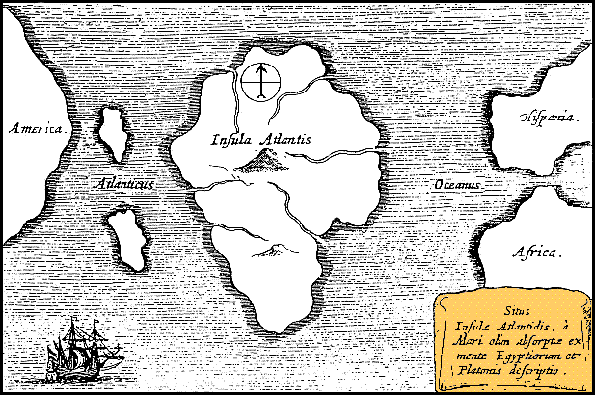
Atlantis

Does New Theory Pinpoint Lost City of Atlantis?

An author’s obsessive quest leads to a site off the coast of Morocco.